
The Breath of the Author
The palpable presence of someone else's mind in our best writing should give us pause about the encroachment of AI text
by Dan Cohen
It is curious — or perhaps completely understandable — that in our overexposed, too-connected global culture, figures like Satoshi Nakamoto, Banksy, and Elena Ferrante still exist, highly influential creators who are largely hidden behind pseudonyms. Sure, investigative reporters have purportedly unmasked the identities of the inventor of Bitcoin, the media-friendly but camera-shy trickster of contemporary art, and, I believe, our greatest living novelist. And yet the three have more or less successfully shrouded themselves.
Why should we care who they are? For Nakamoto, there is the attraction of a beautiful mind, a cryptographic genius, along with a more earthly interest in who is sitting on a mountain of coins worth tens of billions of dollars, like Smaug in The Hobbit. Banksy, on the other hand, seems like a more approachable Gen X figure, politically engaged but with a sense of humor, probably a good hang over a pint at the local pub. Our desire to uncover the real Elena Ferrante feels rather different, however, in a way that crystallizes a point about reading and writing that I have been trying to make in this newsletter as I explore the fraught merger of AI and human effort.
Ferrante’s most beloved books, the four “Neapolitan Novels” beginning with My Brilliant Friend, are narrated in the first person by a character whose name is also Elena (Greco), and are set largely in her hometown of Naples. That she grew up there is one of the few biographical facts “Elena Ferrante” has provided about herself, so we cannot help but assume that this is a work of autofiction, an enthralling blend of pseudonymous autobiography and fiction that hews close to the lived experience of the writer behind Elena/Elena. The potent personal nature of the story — a riveting decades-long arc about an aspiring writer and her destructive frenemy, toxic love interest, and lethal neighborhood — is far more dramatic than most readers’ lives, but Elena Greco’s unstable mix of self-confidence, self-doubt, and self-deception is all too relatable.
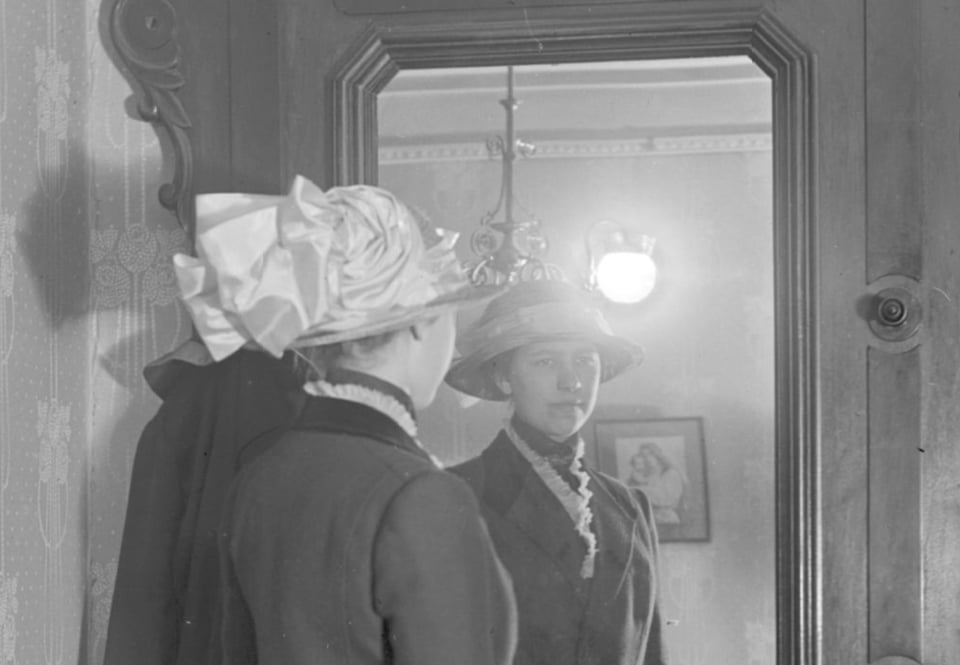
Beyond the great pleasures of the Neapolitan quartet’s direct prose, pacing, and plot, another remarkable feature emerges as the series proceeds. You realize that the four books bend back upon themselves: they are a tale about the source and act of writing the very novels you are reading. They form a circle of mirrors, throwing complex reflections of the relationship between Elena Ferrante (the nom de plume), Elena Greco (the protagonist), and the author of these books.
Instead of being disorienting, these reflections only deepen our identification with the human being behind these novels. She may have a pseudonym — and given the seemingly biographical nature of her works, we can understand why she would want to write under cover — but we nevertheless form an intense bond with this observant writer and come to enjoy the range of her thought. Like many readers, I do not care to know who Ferrante actually is, but I do very much care about and connect to her perceptive and vibrant mind, so generously exposed in her books. This is a heightened version of what we feel when we read any decent novel, or any scholarship that has strong creative intent and displays the experience and views of its author.
As the literary critic Georges Poulet perfectly describes it in his classic essay “Phenomenology of Reading,” in the act of picking up what seems like an inert physical object, a book, one becomes
aware of a rational being, of a consciousness; the consciousness of another, no different from the one I automatically assume in every human being I encounter, except that in this case the consciousness is open to me, welcomes me, lets me look deep inside itself, and even allows me, with unheard-of licence, to think what it thinks and feel what it feels.
We naturally identify and merge with Ferrante’s mind, and the Neapolitan novels explore in depth this inescapable, treasured human process. Elena Greco’s best friend and worst enemy, Lila, has a propensity for what we might today call dissociative episodes — “dissolving margins,” in the more vivid phrase of the novels — in which the boundary between her self and others gives way. Elena eventually sees this as an analogy for writing and reading. The authorship of the books becomes, in a sense, a co-production of Lila and Elena, and also of the neighborhood and Elena, as the author behind the Elenas maps how permeable relationships are, and thus our documentation of them. The reader, in turn, becomes part of that world.
This essential — existential — phenomenon, our sense that we are reading the work of another human being, someone with connections to others, to a time and a place like postwar Naples, someone to whom we might relate our own life stories, is our strongest reason not to cede too much ground to AI-generated text. That holds true whether we’re talking about the pinnacle of contemporary fiction or the scholarly work I have been exploring here. (Admittedly, this might not apply to other, more perfunctory forms of writing that are beyond the scope of this newsletter.) The real problem with AI text isn’t its clichés, which, as I noted in the last essay, can probably be reduced over time; it’s our nagging suspicion of, and eventual annoyance at, the lack of a fellow mind behind the prose. “Elena Ferrante” may be a fake name, but readers never doubt that they are encountering a profound, insightful consciousness.