
A Museum's Sublime Hallucinations
Sometimes you need the fake to show you what's real
by Dan Cohen
I have seen a European mole twice: once in the Harvard Museum of Natural History and once in the Museum of Jurassic Technology, both times in a nice glass display case. Harvard’s taxidermied specimen looked vaguely alive, but uncomfortably pinned to a small wood plank; MJT’s specimen looked very much dead, but resting comfortably on a velvet pillow.

In case you haven’t heard of the Museum of Jurassic Technology, founded in 1988 by David Hildebrand Wilson and Diana Drake Wilson in Los Angeles, it is, in part, “a museum about museums,” as critic Edward Rothstein put it, prodding you to notice what placing an object in a glass vitrine conveys, and what you, the viewer, project onto the object. But it’s dangerous to get too serious about MJT — there’s a tiny skeleton on a velvet pillow.
I’m going to get serious anyway.
In the introductory video just off the lobby, a stentorian voice talks about MJT’s forerunners: ancient collections, perhaps mythical; European cabinets of curiosities; early modern natural history museums; curtained parlors stuffed with the unique and unusual. In MJT’s most memorable phrase, embossed on the back of its official pamphlet and featured in the video, the museum highlights a maxim by Charles Willson Peale, who opened a museum of extraordinary artifacts in 1784 in Philadelphia: “The learner must be led always from familiar objects toward the unfamiliar, guided along, as it were, a chain of flowers into the mysteries of life.”
This quotation, now widely attributed to Peale because of MJT, is not in fact by Peale himself, as I discovered recently doing some research. The line comes instead from Peale’s biographer Charles Coleman Sellers. Indeed, two paragraphs from the introductory MJT video (transcribed on the museum’s glorious HTML 1.0 website, virtually unchanged since the 1990s) appear to be plagiarized from Sellers. Of course, great artists steal, and an untrustworthy, but evocative and profound, quotation is a perfect encapsulation of MJT’s renegade spirit.
The Museum of Jurassic Technology is wildly fun at the same time that it is thought-provoking, which is entirely appropriate given its wide aperture into the weird and wonderful space of the human mind, a catalog of incredible ideas, objects, and activities, some of which are true and some not, and some in the foggy in-between.
In the last issue of this newsletter, I wrote about the origins of revolutionary ideas that transform our understanding of the world. MJT helpfully reminds us of the enormous discard pile of intellectual dead ends, the theories, events, and material culture that are now considered crackpot, lost, or both. These forgotten products of human endeavor can be just as remarkable as the concepts, moments, and objects that succeed, the ones we believe in, remember, and treasure. One gallery in MJT carefully documents the life and thought of the seventeenth-century German polymath Athanasius Kircher, who developed detailed theories in mathematics, Biblical history, medicine, and so many other disciplines. You walk out of the room unsettled by the narrow scope of your own work and the inadequacy of your work ethic, amazed by the unrelenting force of Kircher’s imagination and drive.
Kircher’s strange diagrams and writing share space with fictional figures that seem entirely plausible when placed next to Kircher, such as the fabricated psychologist Geoffrey Sonnabend, whose exhibit is adjacent to a room covering the life of the legendary opera singer Madelena Delani (a/k/a Systana Carvokka, also fictional), who had lamentable issues with her memory, curtailing her career and leading to a dramatic last concert under the Iguassu Falls on the border between Brazil and Argentina. (I know that’s a lot to absorb in one sentence. If you’ve read Thomas Pynchon’s latest novel, Shadow Ticket, it rhymes with Delani’s engrossing international plight.)
Inspired by Delani, Sonnabend (1888-1936) developed a theory of memory in which memory didn’t really exist, or exist as we thought we knew it. In an abridged book available in MJT’s gift shop, Geoffrey Sonnabend: Obliscence, Theories of Forgetting and the Problem of Matter, edited by Valentine Worth (who also does not exist; the (also fake?) Library of Congress record for the book lists several other authors, including, ahem, David Hildebrand Wilson and Diana Drake Wilson), Sonnabend’s philosophy was “predicated on the idea that what we experience as memories are in fact confabulations, artificial constructions of our own design built around sterile particles of retained experience which we attempt to make live again by infusions of imagination.” To this insight, Sonnabend added an eccentric geometrical mechanism, consisting of the “cone” of an individual’s mind passing through the “plane” of experience, in which different conic sections represent distinct perceptions of remembrance and forgetting.
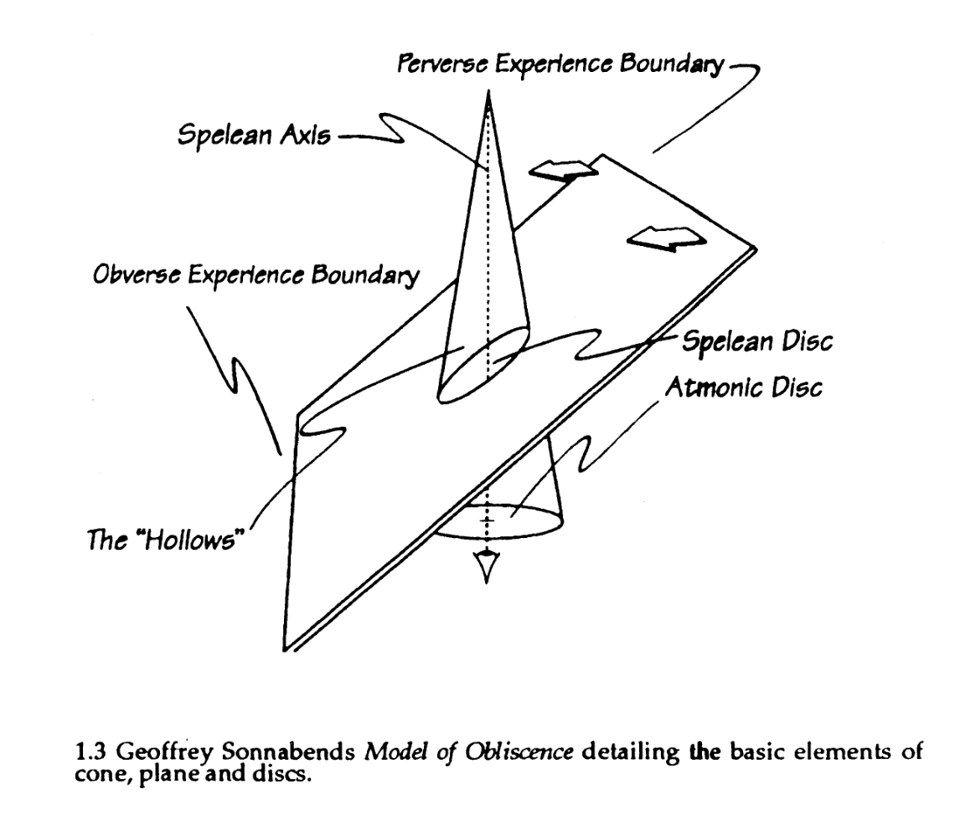
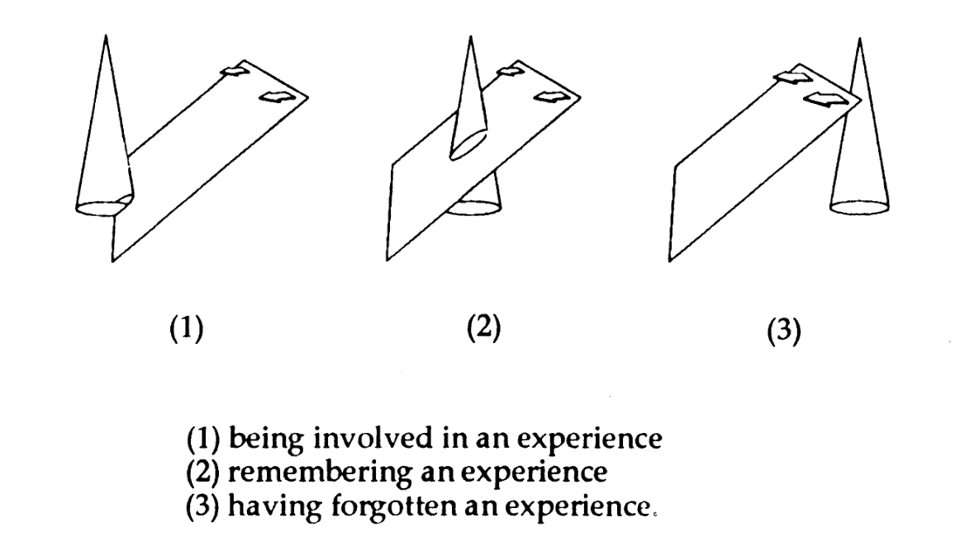
Sonnabend’s theory is abstruse, to be sure, but is his notion of memory as a re-creation rather than a recording so far from our current understanding of memory? Is his combination of mathematics and psychology so different from our interdisciplinary approaches in contemporary neuroscience, albeit limited by the knowledge that existed a hundred years ago? In this frame, Sonnabend’s theory represents, like so many theories in the books and articles from this period, a creative and fascinating but now extinct way of thinking. Sigmund Freud, Sonnabend’s contemporary, also had recondite ideas about memory, but he got the followers and the fame. (Ok, it didn’t help that Sonnabend didn’t exist.)
A visit to the Museum of Jurassic Technology is an invitation to marvel at the miraculous variety of human thought and craft, real or fictional — accentuating one of the great values of museums in general. (And MJT interacts with other museums: as part of Getty’s PST: Art & Science collaboration, they created an exhibit on the very real and truly incredible geometry of medieval Islamic architecture.) It’s hard to imagine artificial general intelligence producing anything like what’s inside MJT, because the engineer’s concept of AGI is so far from the actual human mind, which seems to have an infinite ability to be peculiar and surprising, and to prospect for meaning, understanding, and joy in the strangest of places. As your mental cone slides through the plane of experience, that is worth remembering.
[N.B.: The Museum of Jurassic Technology strictly forbids the use of smartphones or cameras, which helpfully engenders wandering curiosity among the visitors, rather than constant social media snaps in front of tiny skeletons on velvet pillows. The image of the European mole, above, is from a postcard available in their gift shop.]
If someone forwarded you this newsletter, you can subscribe.